
7 Planets, 7 Days of Creation
Relating the Planetary Archetypes to Christian Cosmology

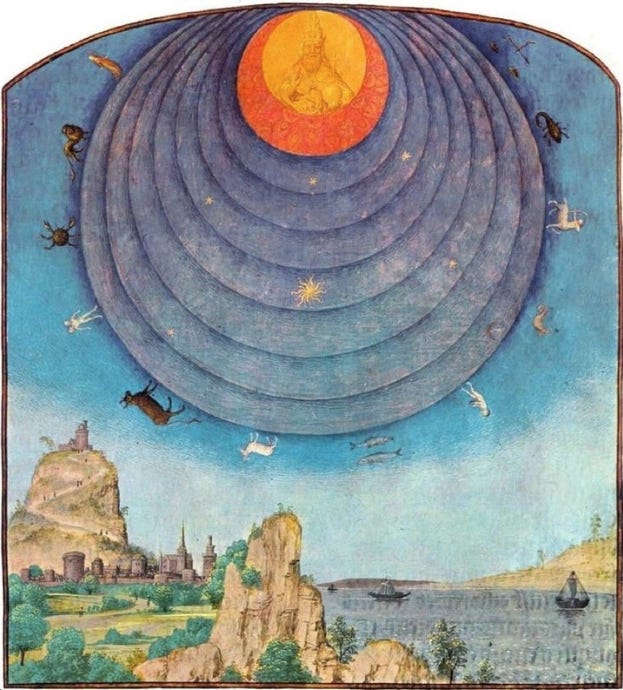
Before I begin this article, I wish to clarify the cosmology on which it is based. Someone who is unfamiliar with astrology, or an ancient worldview in general, might be confused by the order in which these planets are listed. They may even be confused why the Moon and Sun are considered to be planets.
Astrology necessarily requires a geocentric worldview as opposed to a heliocentric one; astrological symbolism is based off of how we view the sky from here on Earth. Because of this, the spheres of heaven are ranked in number by their distance from us and not from the Sun. They are also ranked by the length of time it takes for them to traverse the entire zodiac wheel, from shortest (the Moon takes ~28 days) to longest (Saturn takes ~28 years).
Therefore, the Moon is the closest planet to Earth, Mercury is the second closest, Venus the third, and so on.
Day 1: The Moon
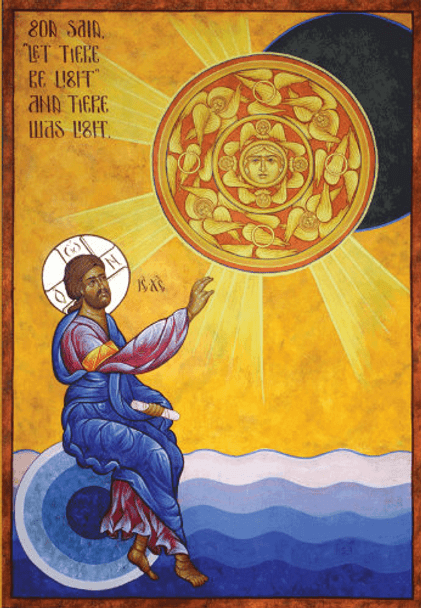
And God said, “Let there be light”: and there was light.
And God saw the light, that it was good: and God divided the light from the darkness.
And God called the light Day, and the darkness he called Night. And the evening and the morning were the first day.
How do we, as humans, experience the Moon? Forget all of our modern scientific knowledge about this “rock” in the sky. Pretend you are a young caveman who barely knows anything about the world. If you looked up in the sky and saw this big bright light slowly disappear and reappear over the course of each month, what would you think of it? What would it come to symbolize in your worldview?
In simple terms, the Moon is the heavenly body that represents the constant exchange between light and darkness. The Moon divides light from the darkness just as God did on the first day.
In Theology of Arithmetic, Iamblichus says that the Lunar archetype is associated with dualism since it constantly appears to split itself into two: a light side and a dark side.
It is important to clarify that darkness itself does not exist, it is merely an absence of light. But negative space is what allows form to exist — things are not only defined by what they are, but also by what they are not.
A dog isn’t merely identified by the fact that it walks on four legs and has hair, it is also defined by the fact that is barks instead of meows — a dog is a dog because it is not a cat nor a frog nor a dolphin.
The interplay between being and non-being, between light and darkness, is the foundation which God uses to create all things. This is the Lunar archetype.
I wrote about the symbolism of the number Two and the nature of duality in a previous article. To get a deeper understanding of this Lunar symbolism, read it here:
The number Two allows the possibility of absence and emptiness, for something to not be. God created light and then separated the light from the darkness, He created the waters and separated the dry land from the sea. Darkness is the absence of light, dryness is the absence of moisture. In order for a piece of marble to become a statue, pieces of marble must be taken away from it. All forms are not only defined by what they are, but equally by what they are not.

The Lunar archetype also represents inward reflection, since it is the light that shines in the darkness while we are dreaming.
To be or not to be: that is the Lunar archetype.
Day 2: Mercury
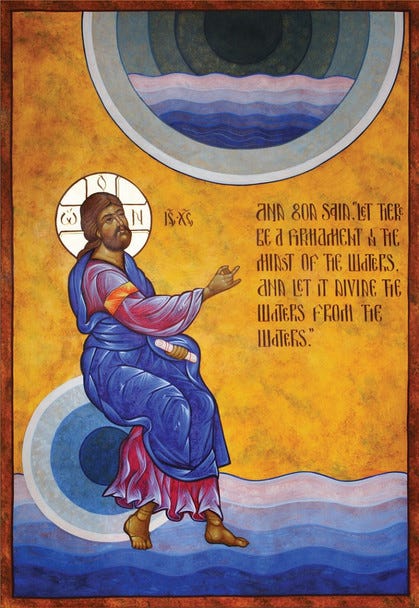
And God said, “Let there be a firmament in the midst of the waters, and let it divide the waters from the waters.”
And God made the firmament, and divided the waters which were under the firmament from the waters which were above the firmament: and it was so.
And God called the firmament Heaven. And the evening and the morning were the second day.
As I have previously mentioned, the heavens can be split into three different layers. The first heaven is considered to be the atmosphere and everything below the Moon. The second heaven, known today as ‘outer space’, is everything between the Moon and God’s throne in the third heaven.
Therefore, since Mercury is the first planet above the Moon, it is the planet that acts as an intermediary between the heavens above and the sky below.
This role is very fitting for Mercury since it is the planet of speech, communication, organization and rational thought. Just like how Mercury was a messenger god, this planet represents the vehicle through which heavenly meaning comes down to Earth: through words.
But the god Mercury doesn’t just share his name with the planet, there is also the metal. Mercury is the only metal element known to man which is liquid at room temperature — it flows like water when it is warm and condenses into a solid when it is cool.
The metal Mercury also has another name: quicksilver. To say that someone possesses a “quicksilver mind” implies that they are good at thinking on the fly — their minds are able to adapt quickly to any circumstance and they always know what to say.
If you think that the connection between Mercury and the firmament is a stretch, here is what St. Basil says about the firmament:
It is not in reality a firm and solid substance which has weight and resistance; this name would otherwise have better suited the earth. But, as the substance of superincumbent bodies is light, without consistency, and cannot be grasped by any one of our senses, it is in comparison with these pure and imperceptible substances that the firmament has received its name. Imagine a place fit to divide the moisture, sending it, if pure and filtered, into higher regions, and making it fall, if it is dense and earthy.
- St. Basil the Great, Hexaemeron Day 2
The firmament is the boundary in the atmosphere which separates the waters above from the waters below, fitting this Mercurial archetype of adapting to changing circumstances.
In short, the Mercurial archetype can be described as the adaptive principle. It is an intellectual faculty which determine what and where something should be.
Just as the metal quicksilver adapts to the surrounding temperature, fluctuating between liquid and solid, the firmament acts as the intelligible and invisible force which perpetually separates the water in the atmosphere from the water on Earth based on their quality.
The flux of light and shadow, which God created in the first day, allows for the possibility of forms. Once those forms are visible, God began to organize them into their proper places: above and below. This is the Mercurial archetype of intelligent adaptation.
Ought or ought not: this is the Mercurial archetype.
Day 3: Venus
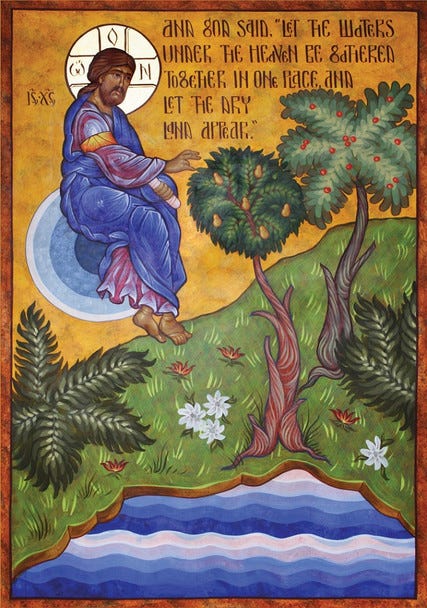
And God said, “Let the waters under the heaven be gathered together unto one place, and let the dry land appear”: and it was so.
And God called the dry land Earth; and the gathering together of the waters called he Seas: and God saw that it was good.
And God said, “Let the earth bring forth grass, the herb yielding seed, and the fruit tree yielding fruit after his kind, whose seed is in itself, upon the earth”: and it was so.
On the Third Day, we not only see the first instance of life, but also the first instance of form in general. Until this point, creation was nothing but water; here we finally see the establishment of land, the place where solid shapes are able to sustain themselves.
It is important to note that this God specifically commands that plants “yield fruit after his kind, whose seed is in itself.”
Aristotle categorized living creatures based on the three kinds of souls they have: a vegetative soul, an animal soul and a rational soul. Plants possess only a vegetative soul, animals possess both a vegetative and animal soul, and humans possess all three. The vegetative soul is the most basic because it is the living force that is behind growth, reproduction and the will to live.
God did not merely plop plants down on the 3rd day, but He created the ability for forms to grow and reproduce themselves on their own — God created the ‘vegetative soul’ as the ancients would call it.
This is one of the most beautiful things about the Christian worldview: the Creator created beings to participate in the His eternal process of creation. All living beings cooperate in the process of creation by recreating themselves in the act of reproduction.
Venus is the 3rd planet in classical astrology. Venus is the planet of love, romantic desire, seduction, sexual receptivity, harmony and generative synthesis between two or more people or objects. Venus is the planetary archetype that joins two things together into one, which what we see on this day when God creates the generative principle of sexual reproduction in plants.
This symbolism of feminine sexuality is even further exemplified by the creation of Land and Sea on this day. Whereas air and fire are considered the two masculine elements, earth and water are the two feminine elements. This is simply because air and fire are active whereas earth and water are passive. The soil of the earth serves as the womb for plants, receiving the seeds of plants and bearing their children; water serves as their nourishment.
The numerology here is extremely fitting. Life first appears on the 3rd day. The Trinity, who is the source of all life, is 3 in 1. The first two days of creation laid the foundations for things to begin to exist, but the number Two is constantly in flux and does allow for forms to arise. Three is the first number of form.
Venus is also the planet of beauty and art. Before Day 3, creation was just a bunch of light and water without self-sustaining form. Not only did God create solid structure on this day, but He also created plants to bring beauty and life to the world.
To receive love and to return it: this is the Venusian archetype.
Day 4: The Sun
And God said, Let there be lights in the firmament of the heaven to divide the day from the night; and let them be for signs, and for seasons, and for days, and years: And let them be for lights in the firmament of the heaven to give light upon the earth: and it was so.
And God made two great lights; the greater light to rule the day, and the lesser light to rule the night: he made the stars also.
And God set them in the firmament of the heaven to give light upon the earth, and to rule over the day and over the night, and to divide the light from the darkness: and God saw that it was good.
And the evening and the morning were the fourth day.
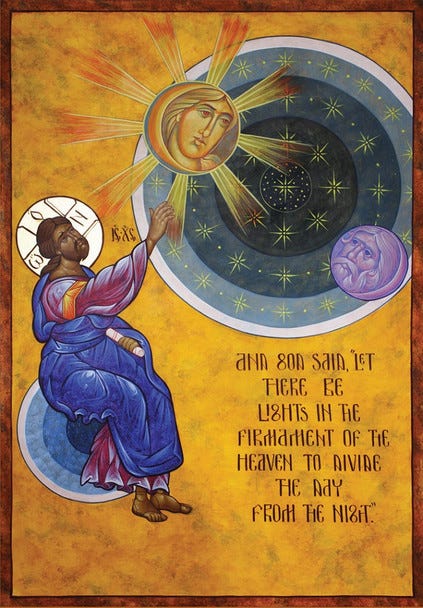
For millennia, critical thinkers have pointed out this obvious quandary within the Creation story: God created the Sun after He created the plants.
How is this possible? Don’t plants need the Sun to live? Obviously, parts of Genesis are meant to be read with a deeper symbolic interpretation rather than a purely scientific one.
It seems to me that for the first 3 days God established the metaphysical ‘prerequisites’ for creation to take place. Day 1 gives us the potentiality of form through the interplay of light and shadow. Day 2 gives us an organizational principle to categorize forms into their proper place (above and below / here or there). Day 3 gives us the ability of forms to sustain themselves, essentially becoming lifeforms.
But growth necessitates the ability to change over time — time is a medium through which things are able to unfold. This is what the creation of the heavenly bodies on the 4th Day signify: the creation of time.
We modern people living in a post-Einsteinian world might conceive of time as some sort of abstract invisible substance that exists independent of the Sun. With all of our scientific theories about the material history of the universe, we conceive of time as something that transcends the physical Sun.
But in reality, the way we experience time is based solely on the Sun. If you were in a bunker underground for a year without any natural light, you would very quickly lose track of time. Even in our scientific theories about the age of the universe are measured in Earth years — the way we measure time is always based on the Sun.
On this day, God creates the Sun, Moon, planets and stars. On Day 1, God created Day and Night, but on this day He created the rulers of Day and Night. The Sun and Moon rule Day and Night because they are the ones who determine when it is Day or Night.
The stars here are specifically mentioned to be created for signs. The zodiac signs signify the 4 seasons, but those seasons only occur when the Sun, Moon, and other planets move through them to define what time it is. The 12 zodiac signs are like 12 hours on the face of a clock, the Sun and Moon serve as clockhands.
There is a reason why the Farmer's Almanac has an entire section talking about astrology and tracking the planets; since ancient times, farmers have known that the cyclical movements of the stars and planets can be directly correlated to the growth cycles of plants.
Now, why would the Sun specifically represent Day 4 when it mentions God creating all of the celestial bodies on this day?
The Sun is the king of the firmament and rules the sky — when the Sun appears in its full glory each day, none of the other celestial bodies can be seen except the Moon. There is a reason why Christ is constantly compared to the Sun in Orthodox hymnography and the Mother of God is compared to the Moon.
If we are to look at this symbolism from a heliocentric worldview, the Sun is the center of the solar system. Also, Day 4 is right in the center between Days 1 and 7.
When the Moon and other 5 planets traverse through each zodiac sign, there are very subtle psychic and spiritual changes that can be measureed. But when the Sun moves through the 12 zodiac signs, everything on Earth changes. The 4 seasons are completely dictated by the Sun’s journey through the 12 signs each year — the cycles of life and death are ruled by where the Sun is in the sky.
The Solar archetype in astrology symbolizes growing towards one’s highest self, fulfilling one’s destiny, becoming all one was meant to be. Without the cycle of the Sun to determine what time it is, there would be no medium for us to grow through.
To live and to grow: this is the Solar archetype.
Day 5: Mars
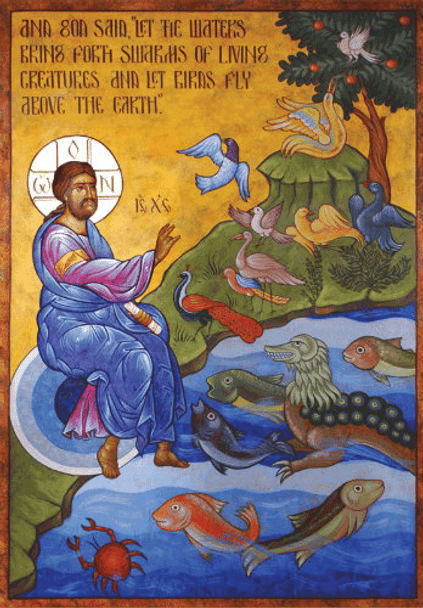
And God said, Let the waters bring forth abundantly the moving creature that hath life, and fowl that may fly above the earth in the open firmament of heaven.
And God created great whales, and every living creature that moveth, which the waters brought forth abundantly, after their kind, and every winged fowl after his kind: and God saw that it was good.
And God blessed them, saying, Be fruitful, and multiply, and fill the waters in the seas, and let fowl multiply in the earth.
And the evening and the morning were the fifth day.
Mars is the planet of eros — Merriam-Webster defines eros as:
the sum of life-preserving instincts that are manifested as impulses to gratify basic needs, as sublimated impulses, and as impulses to protect and preserve the body and mind.
It is the planet of survival instincts, sexual desire, movement and aggression. Mars is the force within you that chases after what it wants — the engine which drives your car.
Mars and Venus are considered to be equal and opposite polar forces in astrology. Libra and Taurus, ruled by Venus, are directly opposite to Aries and Scorpio, ruled by Mars. Naturally, they can be thought of as female and male sexuality respectively.
Whereas Venus represents the attractor, Mars represents the attracted.
Venus pulls, Mars pushes.
Venus is the carrot, Mars is the stick.
Day 3 saw the creation of life, Day 4 provides the medium of time through which life can grow itself. Now on the 5th day, we see the creation of locomotion. Lifeforms aren’t just growing, they are moving now. Day 3 saw the creation of the vegetative soul; on this day, God builds on top of the vegetative soul and creates the animal soul. We can see this common thread of sexual reproduction between Day 3 and Day 5, since God commands the fish and birds to “be fruitful and multiply.”
We also see the Martian archetype of animality balance out the Venusian archetype of vegetative growth. Without the animals consuming the plants, they would grow indefinitely and begin to smother each other — without the plants to bear fruits for the animals, they would starve and eat each other. Plants also need animals to eat their seeds in order to spread them; the same feces that the animal delivers the seed with becomes the fertilizer for the earth to receive it.
This is the interplay between the Venusian force of generation and the Martian force of destruction.
To eat or be eaten: this is the Martian archetype.
Day 6: Jupiter
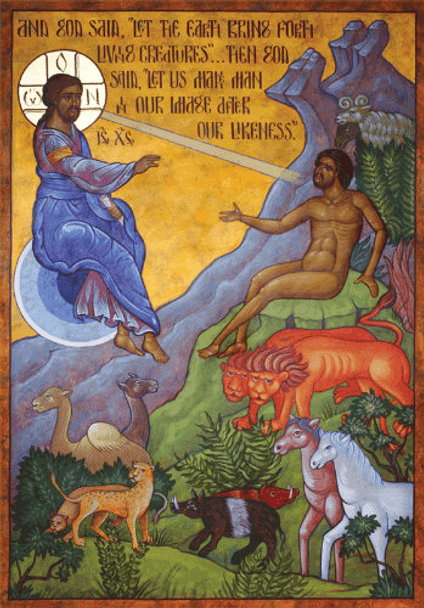
And God made the beast of the earth after his kind, and cattle after their kind, and every thing that creepeth upon the earth after his kind: and God saw that it was good.
And God said, Let us make man in our image, after our likeness: and let them have dominion over the fish of the sea, and over the fowl of the air, and over the cattle, and over all the earth, and over every creeping thing that creepeth upon the earth.
So God created man in his own image, in the image of God created he him; male and female created he them.
And God blessed them, and God said unto them, Be fruitful, and multiply, and replenish the earth, and subdue it: and have dominion over the fish of the sea, and over the fowl of the air, and over every living thing that moveth upon the earth.
And God said, Behold, I have given you every herb bearing seed, which is upon the face of all the earth, and every tree, in the which is the fruit of a tree yielding seed; to you it shall be for meat.
And to every beast of the earth, and to every fowl of the air, and to every thing that creepeth upon the earth, wherein there is life, I have given every green herb for meat: and it was so.
And God saw every thing that he had made, and, behold, it was very good. And the evening and the morning were the sixth day.
Jupiter is the planet of kingship, jollity, fruitfulness, dominion, expansion, prosperity and potentiality.
Man was created by God to be His image and rule over all of creation — how fitting is it that he was created on this day? Man was also created on the same day as all of his royal subjects: the land animals.
Jupiter is associated with virility and just like the plants on Day 3 and the fish/birds on Day 5, God commands humans to “be fruitful and multiply.” But unlike the rest of the living creatures that God created, human beings are very clearly told by God to multiply in order to expand and conquer the earth; we are specifically commanded to “subdue” it and “have dominion” over it.
However, we weren’t commanded by God to be tyrants who rule over nature with an iron fist; God specifically commands us to subdue the Earth and replenish it. Jupiter represents the archetype of the bountiful father who rules over his family, tribe or nation, yet acts as a loving provider.
If Jupiter symbolizes the principles of virility, expansion, and dominion, what better symbol of this than the act of creating more human beings who share the same flesh and blood as you? When you have children, you are creating new iterations of the image of God; their mere presence is an autonomous expansion of your God-given sovereignty over the Earth.
Jupiter also symbolizes philosophy and the pursuit of wisdom, something that only human beings are capable of. On Day 3, we see the creation of the vegetative soul and its ability to grow. On Day 5, we see the creation of the animal soul and its ability to move. On Day 6, we see the creation of the rational soul and its ability to think.
Each new human being brought into the world is full of pure potentiality — within the heart of each human is entire universe waiting to be poured out onto Creation. Unlike the other animals which God created, we have the unique honor of bearing His image. The implication of this is difficult to put into words, but one aspect of being made in the image of God is the fact that we share His creative abilities. We play with potentiality like a child plays with sand in a sandbox — we take the chaotic flux of sand and build sandcastles.
As St. Maximos the Confessor says, human beings are like laboratories who synthesize within ourselves the many logoi of created things:
[…] the human person, which is the laboratory in which everything is concentrated and in itself naturally mediates between the extremities of each division, having been drawn into everything in a good and fitting way through becoming, is divided into male and female. For humanity clearly has the power of naturally uniting at the mean point of each division since it is related to the extremities of each division in its own parts. Through that capacity it can come to be the way of fulfillment of what is divided and be openly instituted in itself as the great mystery of the divine purpose. It proceeds harmoniously to each of the extremities in the things that are, from what is close at hand to what is remote, from what is worse to what is better, lifting up to God and fully accomplishing union. For this reason the human person was introduced last among beings, as a kind of natural bond mediating between the universal poles through their proper parts, and leading into unity in itself those things that are naturally set apart from one another by a great interval.
- St. Maximus the Confessor, Difficulties 41
This is the Jovian archetype: to rule over creation and to create new things with what has been given to us. It is to explore the realm of potentiality and bring forth from it whatever we deem as good.
To rule and replenish: this is the Jovian archetype.
Day 7: Saturn
Thus the heavens and the earth were finished, and all the host of them.
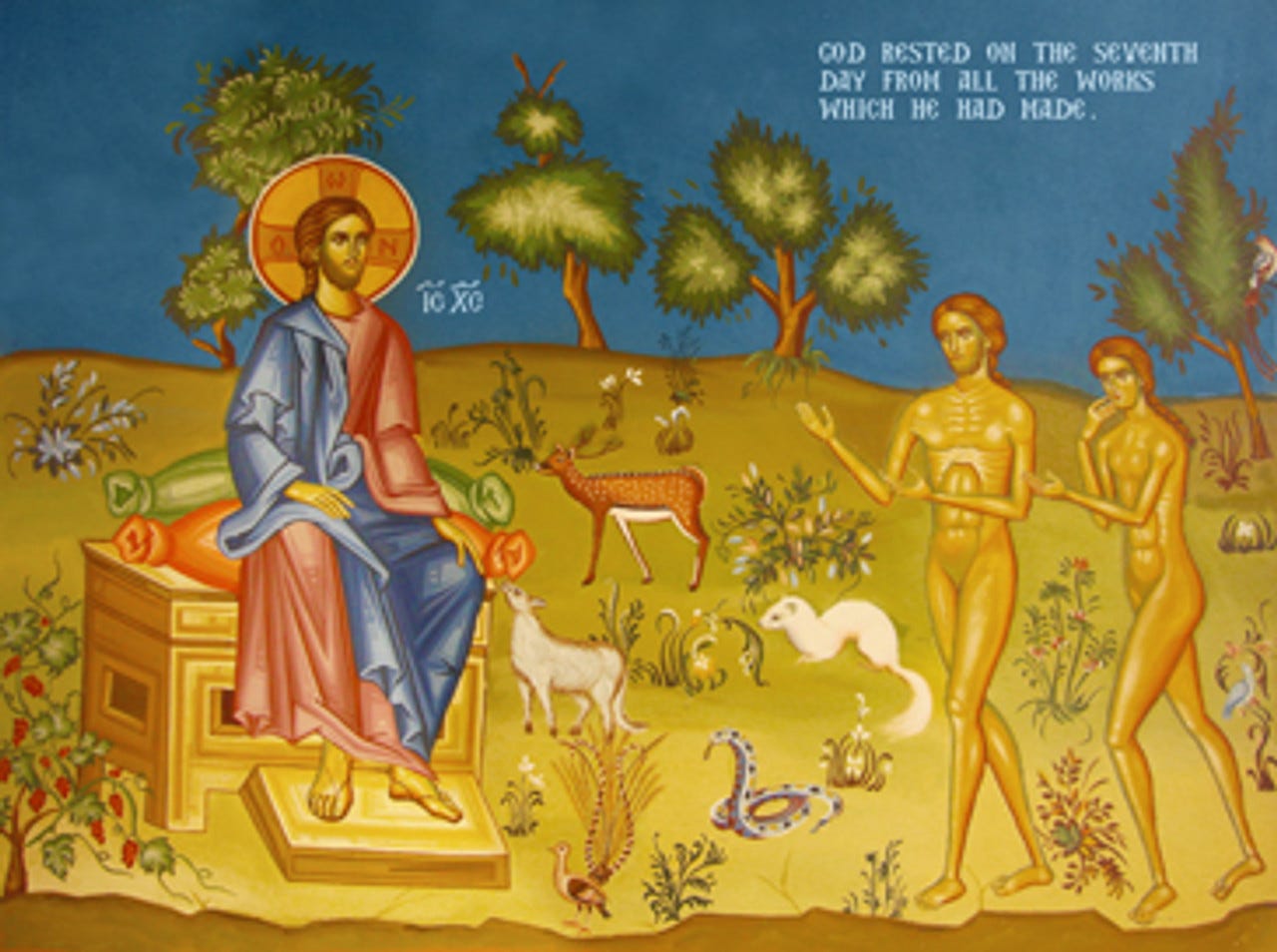
And on the seventh day God ended his work which he had made; and he rested on the seventh day from all his work which he had made.
And God blessed the seventh day, and sanctified it: because that in it he had rested from all his work which God created and made.
These are the generations of the heavens and of the earth when they were created, in the day that the Lord God made the earth and the heavens,
For anyone who thinks that I may be arbitrarily correlating the symbolism of the planets to the days of Creation, the ancient Hebrew name for this planet is enough to prove that these correlations are not merely my own speculations. The ancient Hebrews referred to the planet Saturn as “shabbatai,” which is a name that translates to ‘being of the Sabbath’ or ‘born of the Sabbath.’ It was a name traditionally given to Jewish boys who were born on the Sabbath day, which was Saturday. Saturday itself was attributed to the god Saturn by the Romans, hence the name: “Saturn’s day.”
Just like how Venus and Mars are seen as polar forces, Jupiter and Saturn can be seen as polarities. Whereas Jupiter is potentiality, Saturn is actuality.
Saturn is the planet of limitations, restrictions, boundaries, obstacles, and judgement.
Now, you may be thinking: what does God resting on the 7th day have to do with any of the Saturnian archetypes I listed above?
God resting does not imply that God is idling, Christ Himself says otherwise:
16 For this reason the Jews persecuted Jesus, and sought to kill Him, because He had done these things on the Sabbath. 17 But Jesus answered them, “My Father has been working until now, and I have been working.”
- John 5:16-17
Saturn, which symbolizes limitations, marks the limits of what can possibly exist within Creation. While we contain within ourselves the Jovian force to create new things out of potentiality, there are not an infinite number of possibilities to work with. The ingredients we are given to work with are confined within the categories of being which God created in 6 days; the 7th day marks the boundary and the end of potentiality.
God has already done all of the work to creating the universe, this is what He is resting from. However, this rest is simultaneously an act of gazing upon Creation and judging it.
The god Saturn in Greco-Roman mythology is the god of time (hence his Greek name Chronos) and is depicted as an old man with a scythe. This is also why the Grim Reaper is depicted holding a scythe — time has ran out. There is no more potentiality, no more time to grow or change. This is also why the god Saturn eats his own children. Unlike Jupiter who is the providing father, Saturn is the consuming father.
In short, Saturn is the planet of the harvest.
I think this is why Saturn has become perceived as an “evil” planet within mainstream conspiracy theories; the concept of being harvested is terrifying to us. But this terror is exactly why Christ uses the analogy of harvesting numerous times throughout the Gospels in order to scare us straight.
He uses it in the parable of the talents, warning us not to waste the potentiality that God has gifted us to do good:
24 “He also who had received the one talent came and said, ‘Lord, I knew you that you are a hard man, reaping where you did not sow, and gathering where you did not scatter.
25 I was afraid, and went away and hid your talent in the earth. Behold, you have what is yours.’"
26 “But his lord answered him, ‘You wicked and slothful servant. You knew that I reap where I didn’t sow, and gather where I didn’t scatter."
- Matthew 25:24-26
He also uses the analogy of reaping in reference to the Last Judgement:
24 Another parable put He forth unto them, saying, The kingdom of heaven is likened unto a man which sowed good seed in his field:
25 But while men slept, his enemy came and sowed tares among the wheat, and went his way.
26 But when the blade was sprung up, and brought forth fruit, then appeared the tares also.
27 So the servants of the householder came and said unto him, Sir, didst not thou sow good seed in thy field? from whence then hath it tares?
28 He said unto them, An enemy hath done this. The servants said unto him, Wilt thou then that we go and gather them up?
29 But he said, Nay; lest while ye gather up the tares, ye root up also the wheat with them.
30 Let both grow together until the harvest: and in the time of harvest I will say to the reapers, Gather ye together first the tares, and bind them in bundles to burn them: but gather the wheat into my barn.
- Matthew 13:24-30
The Jovian archetype of creativity is put to the judgement here by God — are the things we created bearing good fruit to be harvested? Or are they wasteful and deserve to be cast into the fire?
Interesting! Yet another new angle through which to appreciate creation.
Your point on Mercury’s relation to the firmament might perhaps be strengthened by the Hebrew.
רָקִ֖יעַ ‘raqia’ (Gen 1:6) - the word translated ‘firmament’ - comes from the verb רָקַע ‘raqa’ which refers to the action of beating or shaping molten metal. (You see this connection in Rabbinic commentary; Gen. Rabba 4:5)
The same verb is used for the golden overlay of the furniture of the tabernacle and the high priests garments (Exod 39:3) all of which Josephus connects with the cosmos and planets.
The planets, stars, and sun and moon are then ‘set’ in the firmament on day four (Gen 1:17), much the same way the precious stones are ‘set’ in the breastplate, (Exod 28:1) and the garments, of the high priest. (Though these are different verbs in Hebrew)
Your comments on the Sun as Christ, and the Sun ‘adorned’, might we say, with the zodiac, made me think of Christ, the great high priest, adorned with glory.
Connections like this blow my mind.
Wow, this is good stuff. I've been realizing so much of this symbology and archetypical language used by the ancients isn't so much a religion that's a threat to Christianity, but instead a symbolic language that Christianity can be spoken of in.
Through nominalism moderns just kind of forgot this meta language existed and have misrepresented this all as archaic fables when it's so much more and actually relevant to understanding our world and why everything is so messed up, as these principles are all out of whack in modernity and everything has been flattened and blended together.